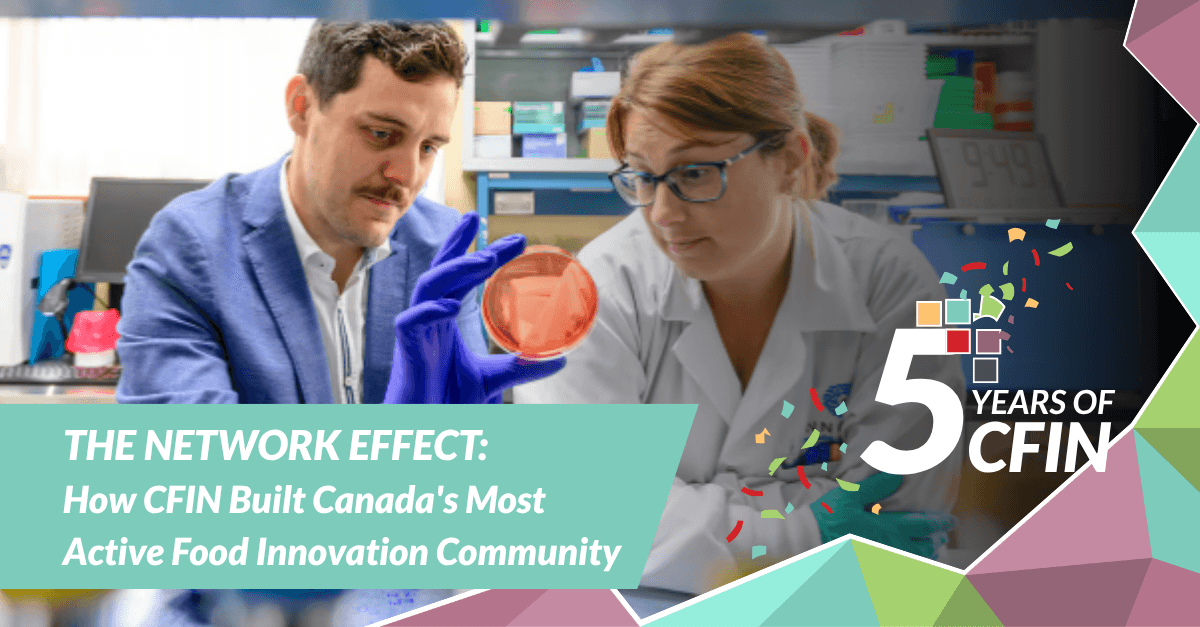
CFIN was founded in 2021 on a specific premise: Canada's food sector needed a national network to connect an industry that had been operating in siloes for decades.
The premise turned out to be right. The community now stands at more than 8,500 members — adding 150+ every month — with representation from every province, every part of the value chain, and every stage of business from pre-revenue startups to billion-dollar processors.
Here's a closer look at what that network looks like five years in.
The Network by the Numbers
CFIN’s membership spans the full food value chain: manufacturers, processors, distributors, operators, tech companies, funders, researchers, and innovators. YODL, CFIN's community platform, has quietly become one of the most active food business hubs in the country. It sees over four hundred thousand unique page views per year, up to 1,500 unique member logins per month, and more than 8,000 individual posts and contributions since 2022.
For a growing number of Canadian food businesses, YODL is the first place they go when they need a collaborator, a co-packer, or a second opinion on a new idea.
Supporting Member Organizations by Building Connections
The connective tissue of the CFIN community is our team of Regional Innovation Directors, who have supported more than 2,200 organizations since 2021. Their work defies tidy summarization: it can look like a call with a founder in Halifax who needs a co-packer, a warm intro between a scaling startup and the senior hire who ends up running their go-to-market, or connecting two companies in different provinces solving adjacent problems who should probably know each other.
RIDs broker the relationships that lead to commercial partnerships and new customers. Crush Dynamics got an introduction to A&W for a formulation opportunity. Supply chain software firm Owl Solutions met RDJ Bakeries, one of the country's largest commercial cracker manufacturers. Innodal and Index Biosystems, two companies in entirely different corners of food safety innovation, formed a strategic partnership after CFIN brought them together. When Laplace Robotics needed experienced leadership for their go-to-market strategy, CFIN sourced the advisor who became their Head of Project Development.
CFIN also helps connect companies to capital. For example, Food Cycle Science met Power Sustainable Lios through CFIN — a relationship that led to one of the most significant strategic investments we've seen in Canadian foodtech. The academic connections run deep as well — Holland College's Smart Kitchen, Niagara College's Food and Beverage Innovation Centre, NAIT, UBC Food Science, Conestoga's Food Research and Innovation Lab, and many others have been connected to industry partners across the country, advancing partnerships and helping researchers commercialize made-in Canada IP.
These aren't the connections that make press releases. But they are the ones that end up shaping the trajectory of a business.
What Comes Next
Canada's food and beverage sector is a $150-billion industry built overwhelmingly on small and mid-sized businesses. Most of them don't have an R&D department. Many don't have a network beyond their region or their immediate supply chain. For decades, that isolation was just how the industry worked — everybody solving the same problems independently, often without knowing someone three provinces had the solution they needed.
That's the capacity gap that CFIN was created to fill. Five years and 8,500 members later, the question isn't whether the network was needed. It's how much further we can go together.