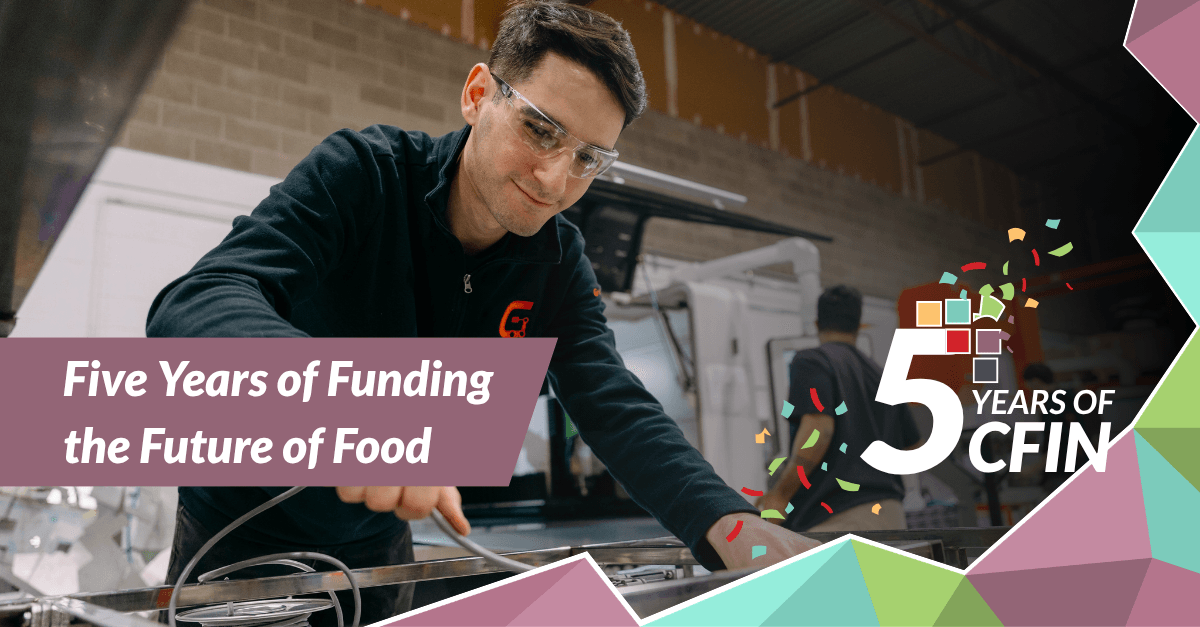
Five years ago, CFIN set out to do something that hadn’t been done in Canada: build a national engine for food innovation that connects startups with funding, processors with new technology, and an entire sector with the tools to compete globally. Half a decade later, the results speak for themselves.
Since 2021, CFIN has received more than 700 applications across its funding programs, awarded over $23.3 million to 133 projects through five program streams, and watched those investments help unlock nearly $100 million in follow-on private capital—a four-to-one multiplier that demonstrates how targeted public funding can catalyze market confidence and commercial growth.
But the numbers only tell part of the story. Behind every funded project is a company tackling a real problem: a robotics startup building autonomous kitchens to address labour shortages, a biosensor company making food safety testing faster and cheaper, a fermentation venture turning winery waste into functional ingredients. These startups are building what we call Food 4.0: a tech-enabled Canadian food system that’s smarter, more productive, more sustainable, and more resilient.
What matters more than the numbers is what they represent: a national pipeline that takes promising food technology from concept to commercial traction, and an ecosystem of companies proving that Canadian innovation can compete globally.
Six Programs, One Food Innovation Pipeline
Each of CFIN's funding streams targets a different stage of the innovation journey:
Innovation Boosters ($6.2M across 77 projects) are the workhorse of CFIN’s program portfolio. These grants help companies develop, test, and refine specific technology applications — Cronometer's AI food suggestions engine, Freshr's packaging-integrated shelf life system, Fresh Prep's AI-powered virtual nutrition advisor. They're smaller bets with faster project timelines, designed to generate commercial proof points that help companies attract customers and investors.
The Food Innovation Challenge ($11.1M across 8 projects) goes bigger. These are large-scale collaborative investments — up to $4 million per project — in transformative ideas that bring together multiple partners. From Gastronomous Technologies' autonomous ChronoGrill charbroiler to Innodal's natural antimicrobial platform for food preservation, the scale of funding matches the scale of ambition.
FoodTech Next ($4.1M across 18 projects) funds early-stage tech companies that need to demonstrate and pilot their solutions in real operational environments. This is where Relocalize's autonomous microfactories got their first commercial pilot with Southeastern Grocers and where CanDry Technologies customized its dehydration system for berry and spent grain applications
Ontario Food Technology Pilot ($1.7M across 18 projects) is CFIN's newest program, funded in part by FedDev Ontario. It supports southern Ontario-based startups piloting food technologies in commercial settings — companies like Jitto, Biofect Innovations, Truely Foods, Otolabs, Sustainable Biosecurity Solutions, and Mindlab.
Unpuzzling Green ($130K across 7 projects) is an Atlantic Canada-focused program, delivered in partnership with ACOA, that provides rapid support to food and beverage manufacturers looking to analyze and improve the sustainability of their operations.
NextGen Food Innovators ($49K across 5 projects) supports student entrepreneurs at Canadian colleges and universities who are developing IP-driven food technologies. One funded venture from each of CFIN's five regions — Atlantic, Quebec, Ontario, Prairies, and BC/Yukon — working on everything from seaweed-based bio-coatings to AI-enabled cultivated fat product development.
Where the Funding Flows — and What It Grows
That funding spans eight technology domains — from next-generation ingredients and kitchen automation to digital supply chains, food waste circularity, packaging, food safety, and consumer platforms. NextGen Food & Ingredients leads at 22% of all submissions and nearly $7.7 million awarded, followed by Kitchen & Restaurant Tech and Food Manufacturing Technologies at 14% each. The distribution tells us where the sector sees its biggest opportunities and its most urgent needs.
The momentum that companies build coming out of these programs are proving the model:
- Relocalize built off a FoodTech Next pilot with Southeastern Grocers to close a $5.8 million seed round.
- ThisFish expanded its traceability platform with CFIN support and now earns 90% of its revenue from international clients across Asia and Latin America.
- Fresh Prep used an Innovation Booster to develop AI-powered nutrition tools — the company has since grown into a $100-million national meal kit brand.
- Innodal used CFIN funding to optimize its antimicrobial platform and went on to secure FDA GRAS approval in the United States
We recently documented these program success stories, along with many others, through our Canada's Foodtech Frontiers article series — profiling the companies, investments, and opportunities across all eight of CFIN’s innovation domains:
- NextGen Food & Ingredients — Fueling the Future
- Kitchen & Restaurant Tech — Automating the Back of House
- Food Manufacturing Technologies — Building the Factory of the Future
- Digital Supply Chain Solutions — From Static to Smart
- Food Waste & Circularity — Creating Circular Value
- Food Safety & Traceability — Gaining Global Traction
- Food Packaging — Reinventing the Wrapper
- Consumer Apps & Services — Meeting Canadians Where They Eat
What Five Years Have Taught Us
Looking back on our first five years of funding program, three lessons stand out.
First, the demand is real and it's growing. More than 700 applications tell us that Canadian food innovators are actively seeking the kind of support CFIN provides — not just dollars, but validation, structure, and a pathway to commercial traction.
Second, the challenges that CFIN’s programs address are structural. Across every technology domain, the same friction points surface among applicants: a capital gap between pilot and scale, fragmented regulation, workforce skills shortages, and an SME-dominated sector with limited capacity to absorb new technology. These aren't problems any single program solves. They're problems an ecosystem addresses — which is why CFIN's role as a connector matters as much as its role as a funder.
Third, the program pipeline works. Companies enter CFIN programs with promising technology. They leave with proof points, commercial relationships, and investor confidence. The four-to-one ratio of follow-on capital is the outcome of that progression.
What Comes Next
Five years in, CFIN has helped create a growing pool of homegrown food technology solutions, connected a national community increasingly united around shared challenges, and built a cohort of tech adopters ready to make Canada's food system more productive and resilient.
That's the foundation we’ve built. What gets built on top of it over the next five years will be even more exciting.